Signs your fuel pump relay may be failing
- The usual signs are an engine that cranks at normal speed but won't fire, a sudden stall, and starting trouble that comes and goes, sometimes only when the engine bay is hot.
- A failing pump, bad wiring or a fuel delivery fault can look exactly the same, so these signs point at the fuel pump circuit, not one particular part.
- If the engine died while you were driving, park it and get it diagnosed before you drive again.
- Pay for electrical testing before anyone sells you a relay, a pump or something bigger.
Maybe it cranked forever this morning and then fired on the second try, or it cut out at a light and restarted like nothing happened. We'd let the symptom decide how urgent this is and leave naming the part to someone with electrical test gear, because a dying pump and a dying relay behave the same way and only proper testing tells them apart.
It cranks at normal speed but won't fire
The starter spins the engine like it always does, yet no fuel arrives, so it never catches. That combination is one of the textbook relay signs, especially when you also don't hear the fuel pump come on as the engine cranks.
Here's why a relay can do this. When it fails, it cuts the electrical circuit to the pump completely, so the pump never runs. In a large group of recalled vehicles, a failed fuel pump relay was documented as causing exactly this kind of no-start.
The same picture can come from beyond the relay, too. If the relay is doing its job and fuel still isn't arriving, the pump motor, its wiring or the fuel delivery system becomes the suspect instead.
Pay attention to what happens on the next try. A failing relay sometimes lets the car start normally right after a failed attempt, and that's a useful detail to pass on to whoever works on it.
The engine died while you were driving
An engine that runs fine and then suddenly quits is another recognized relay sign, and it's the one we'd treat as urgent. The bigger risk here is losing the engine in traffic.
NHTSA recall records show how serious this can get. One recall covered about 335,000 vehicles whose power module (the TIPM) had an internal fuel pump relay that could work intermittently or fail without warning, and a relay failing that way could stall the engine while driving and cause a crash without warning.
A follow-up recall covered about 582,000 vehicles that may have received a replacement relay prone to silicon contamination on its contacts. When that relay fails, the result can be a no-start, or a stall if the engine is running.
Those figures belong to the recalled vehicles only. The danger carries over to any car, though: an engine stall while driving can cause a crash with no prior warning, so a single stall is reason enough to get answers before the next drive.
It won't start when hot, or only on some days
Two more patterns show up among relay failure signs: a car that refuses to start when the engine compartment is hot, and starting trouble that follows no pattern you can spot.
Both fit how relays age. Contact oxidation, coil wear and damage from repeated heating and cooling typically make a relay work on and off before it quits for good.
That on-and-off stage is also what makes these faults hard to pin down. Intermittent problems are among the toughest electrical faults to diagnose reliably, and catching one takes specialized test equipment and technique.
Your notes help close that gap. Write down how hot the engine was, how long you'd been driving and whether it restarted, because an intermittent fault won't always show up on demand.
Telling a bad relay from a bad pump
Fuel pump failures and relay failures produce identical symptoms. A matching symptom tells you the fuel pump circuit needs attention, but it doesn't, by itself, name the part that failed.
Plenty of other faults in and around that circuit can stop the pump too, and from the driver's seat they look much the same.
- Poor connections that drop the voltage reaching the relay
- A weak ground that keeps the relay from working properly
- An anti-theft system that blocks the fuel pump
- CAN bus network trouble, which affects several systems at once
- A failed pump motor, damaged wiring or a fuel delivery problem
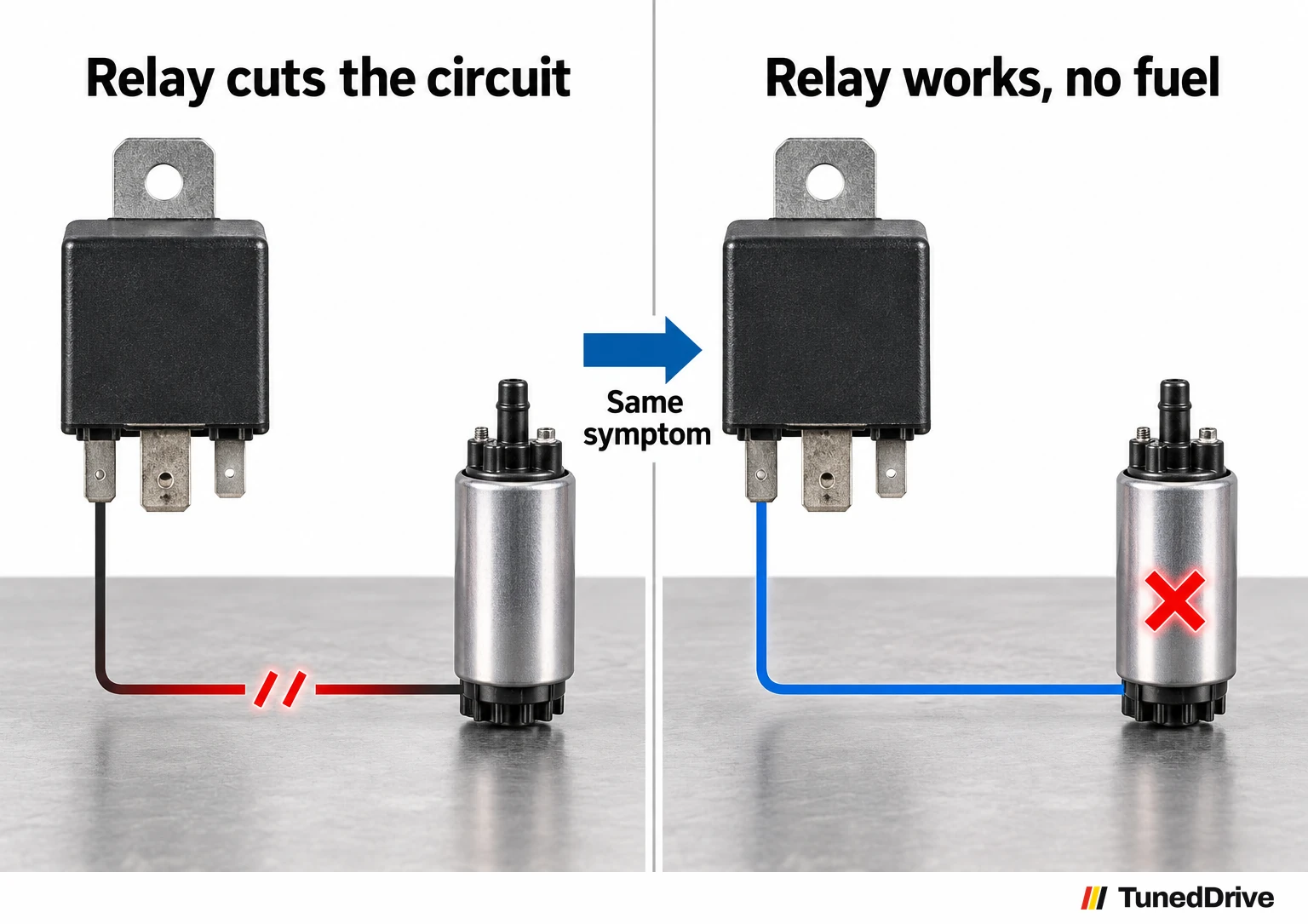
Even finding the right relay is part of the puzzle. Many vehicles have more than one fuel system relay, and manufacturers place and label them differently, which is why accurate identification matters for a correct diagnosis.
Security systems add another layer, since modern anti-theft integration complicates what used to be a straightforward relay check.
What wears a fuel pump relay out
When the relay really is the culprit, the wear traces back to a familiar set of stresses: high current loads wearing the contacts, heat cycling, vibration loosening internal connections, moisture corrosion and age-related oxidation.
One of those loops back to the pump. A failing pump draws excessive current, and high current is exactly what wears relay contacts.
A relay that fails more than once is pointing past itself. Repeat failures suggest a circuit overload or a control module problem, and a bad relay often signals an underlying circuit fault.
Part quality matters too, because cheap replacement relays can fail quickly under high current loads. That's worth raising if your car already had a relay replaced and the symptoms came back.
Earlier recall work belongs in that history. On vehicles that had FCA's Safety Recall P54 (NHTSA 14V-530) or R09 (NHTSA 15V-115) completed, the installed remedy relay can suffer silicon contamination on its contacts and fail. NHTSA's follow-up recall notice (opens in a new tab) describes that later campaign.
Get the circuit tested before anyone replaces parts
Our advice is to pay for proper electrical testing first. Buying expensive components on a hunch is the costly way to learn they weren't the problem.
Complex electrical problems need professional diagnostic equipment and expertise. Modern cars tie control modules into the pump circuit, so a scan tool is part of the job.
A good diagnosis goes further than fitting a new relay. Circuit analysis, voltage drop testing and control module checks catch faults that basic testing misses.
The aim is the root cause behind your symptom. A shop that tests the circuit step by step before quoting parts is the one to trust with an intermittent fault.
What to tell the shop
Intermittent faults are hard to catch on cue, so your notes give the technician a head start. Lead with any stall on the road, since that's the symptom with a crash risk attached.
Jot these down before you call.
Tick what applies and add details; the note above fills in as you go.
Questions drivers ask
Does a failing relay give any warning first?
Often it does. Relays typically wear gradually and work on and off before failing completely, which is where intermittent starting trouble comes from. The recalled power-module relays could fail without warning, though, so the first sign can be the breakdown itself.
If the car starts again, is the problem gone?
Not necessarily. A failing relay can let the car start normally right after a failed attempt, and on-and-off operation is typical before a relay fails completely.
Why does the shop want to plug in a scan tool?
Modern fuel systems run through control modules with OBD-II diagnostics, and reading those electrical codes correctly is what separates a sound repair from an expensive misdiagnosis.
Will a new relay fix it on its own?
It can if the relay was the only fault, but bad relays often point to an underlying circuit problem. If the symptoms stay after a relay replacement, further diagnosis needs professional tools and expertise.
More in this category