Read the date before judging the tread
- Find the DOT marking on the sidewall and read its final four digits. The first pair gives the manufacture week; the second gives the year.
- Michelin recommends a close inspection after five years and replacement by ten years from manufacture, regardless of tread depth.
- Use the date alongside tread wear and overall condition when deciding whether the tire is usable.
If you're looking at a tire with plenty of tread left, we'd check its manufacture date before deciding to keep it, because Michelin's age-based replacement recommendation applies regardless of tread depth. That gives you a concrete calendar reference to weigh alongside what condition the tire is in.
You're answering two separate questions: when the tire was made, and whether it's still suitable to use. The marking answers the first directly. For the second, combine the decoded date with Michelin's age guidance and its qualification that tread wear and overall condition are critical.
Which part of the sidewall marking to read
Look for the letters DOT on the tire's sidewall. DOT stands for Department of Transportation, and the date is part of that marking. Follow the marking to its end and identify the final four-number sequence, which is the portion you'll decode.
Keep those four digits together when you write them down. You'll split them into two pairs next, so preserving their order matters: the pair on the left and the pair on the right describe different parts of the manufacture date. You can compare the format with Michelin's tire date-code explanation (opens in a new tab).
Focus on the end of the DOT marking, rather than treating its beginning as the date. Michelin identifies a terminal four-digit sequence for this reading method. Once you've isolated that sequence, you have the information needed to express the production date as a week and a year.
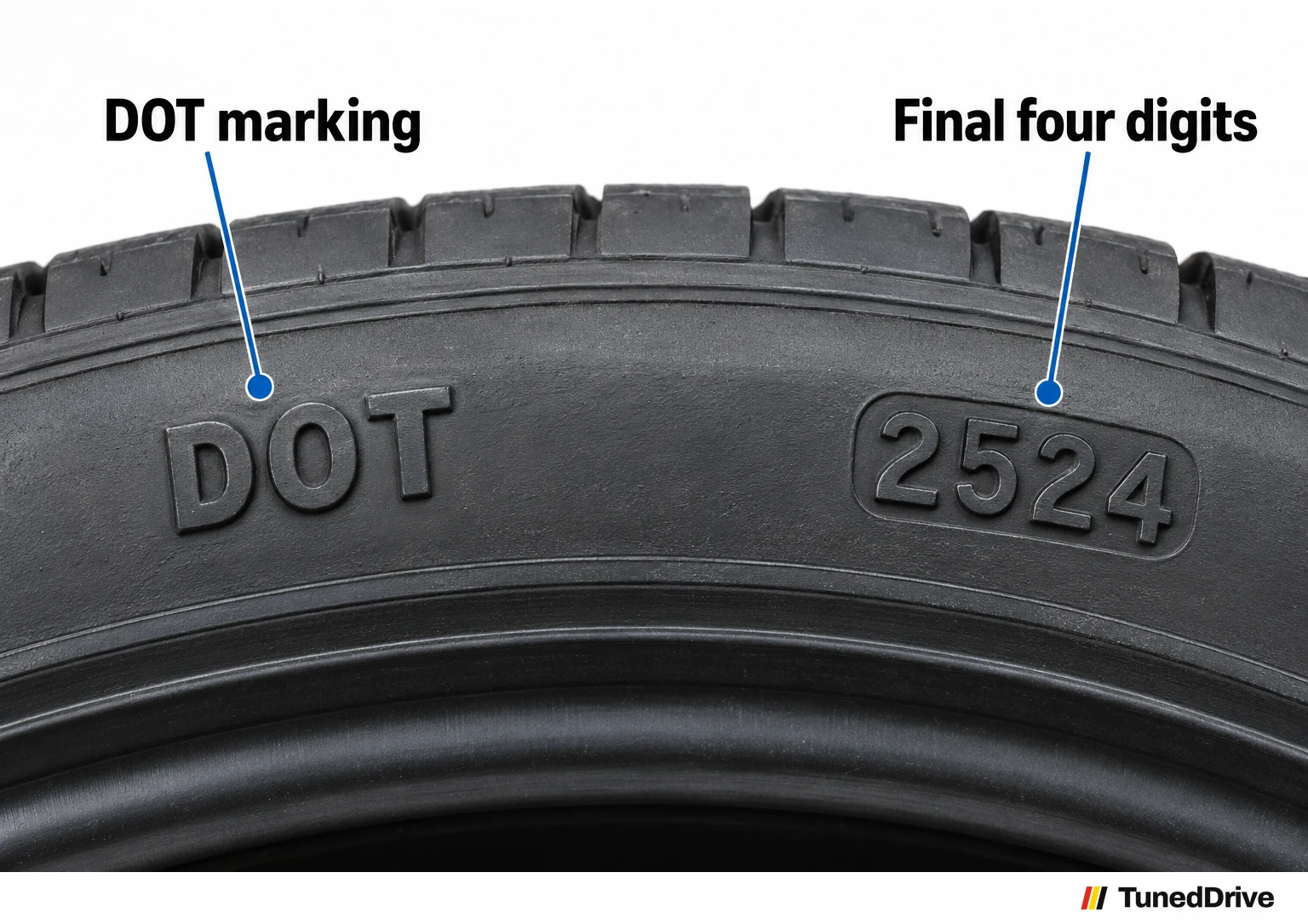
Turn four digits into a useful date
Read the first two date digits as the week of manufacture and the last two as the year. This is a week-and-year format, so interpreting the first pair as a calendar month changes the meaning. Keep the two pairs in their printed order as you decode them.
For Michelin's example 2524, split the sequence into 25 and 24. The 25 means the 25th week of the year, and the 24 means 2024. Write the result as “25th week of 2024” so your note preserves both parts of the date instead of just the year.
The other example, 4714, reads as the 47th week of 2014. Here, 47 describes where production falls within the year, while 14 identifies the year itself. The same reading method works for both examples, even though their manufacture dates are quite different.
Check your transcription by matching each part of your written date back to its pair of digits. For 2524, your week should come from 25 and your year from 24. Keeping that connection visible helps when you move from decoding the marking to calculating the tire's age checkpoints.
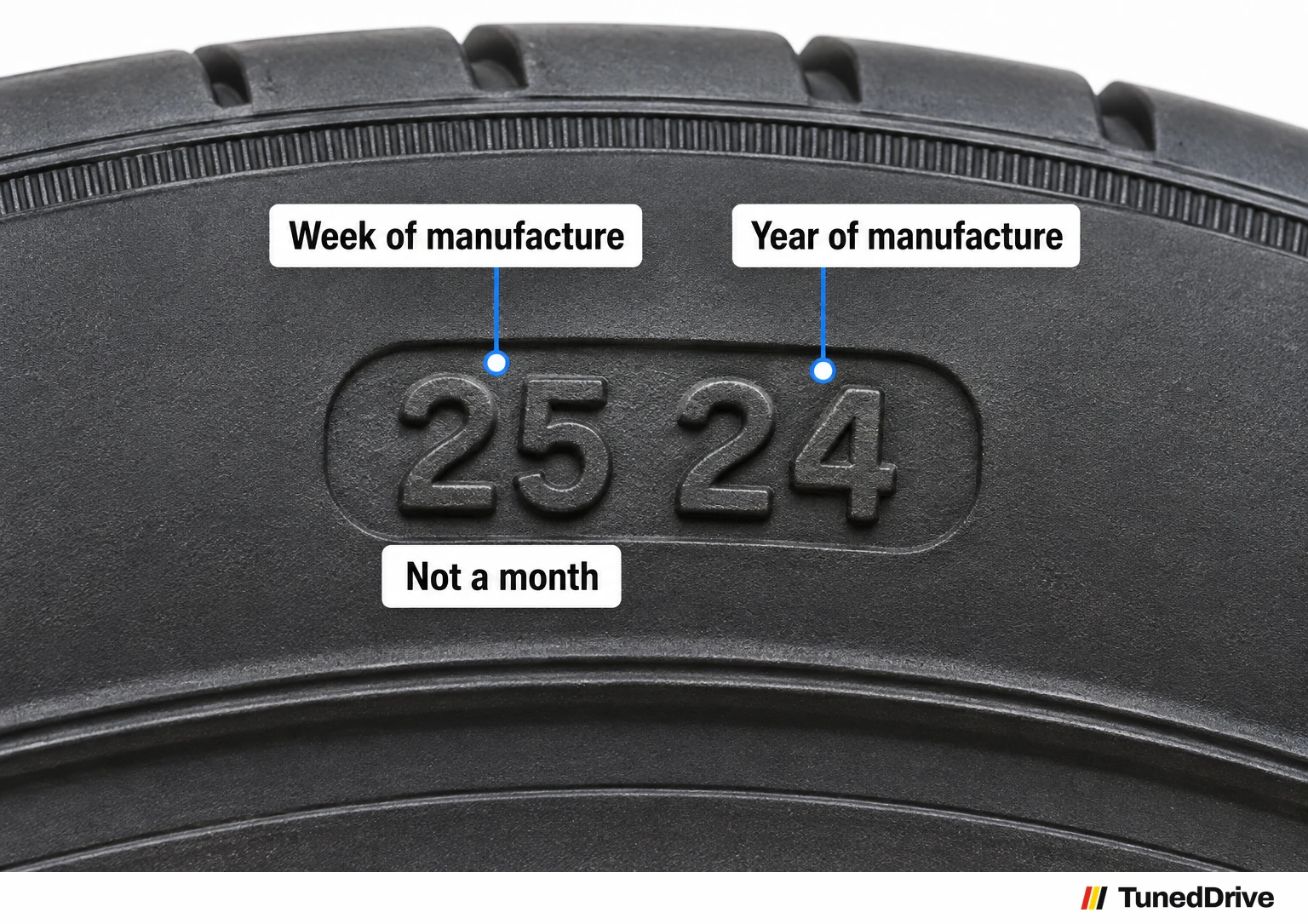
Put Michelin's checkpoints on the calendar
Count forward from the manufacture date you've decoded. Michelin's five-year checkpoint calls for a close inspection, while its ten-year point calls for replacement. Those are different decisions: reaching the inspection checkpoint means considering the tire closely at that stage, while the later recommendation sets an age-based replacement limit.
Using 2524 as a worked example, adding five years to the 25th week of 2024 puts the five-year point in the 25th week of 2029. Adding ten years puts the replacement point in the 25th week of 2034. These dates are arithmetic based on the printed manufacture date and Michelin's stated intervals.
For 4714, the same calculation puts the five-year point in the 47th week of 2019 and the ten-year point in the 47th week of 2024. Comparing that result with the 2524 example shows why the year pair matters so much: the code determines which calendar years you're working toward or have already passed.
Keep the recommendation attached to its maker when you use it. These are Michelin's inspection and replacement checkpoints (opens in a new tab), measured from manufacture. If you're making a note for future reference, label the earlier date “close inspection” and the later date “replacement by” so the two actions stay distinct.
How condition changes the decision
A tire younger than the replacement threshold isn't automatically usable; tread wear and overall condition remain critical. Use the age calculation to establish where the tire sits on the calendar, then include its present condition in your decision about continued use.
That makes the years before the replacement point a period in which condition still matters. A future date in your notes tells you when Michelin's age-based replacement recommendation comes due. Your decision today still needs to account for the tire's wear and overall condition, including when the five-year inspection checkpoint is still ahead.
At the ten-year point, remaining tread doesn't extend Michelin's recommendation. If your decision is “it still has tread, so should I keep it beyond that date?”, follow the replacement recommendation. The tread qualification and the age limit work together: condition matters before the limit, and tread depth supplies no extension beyond it.
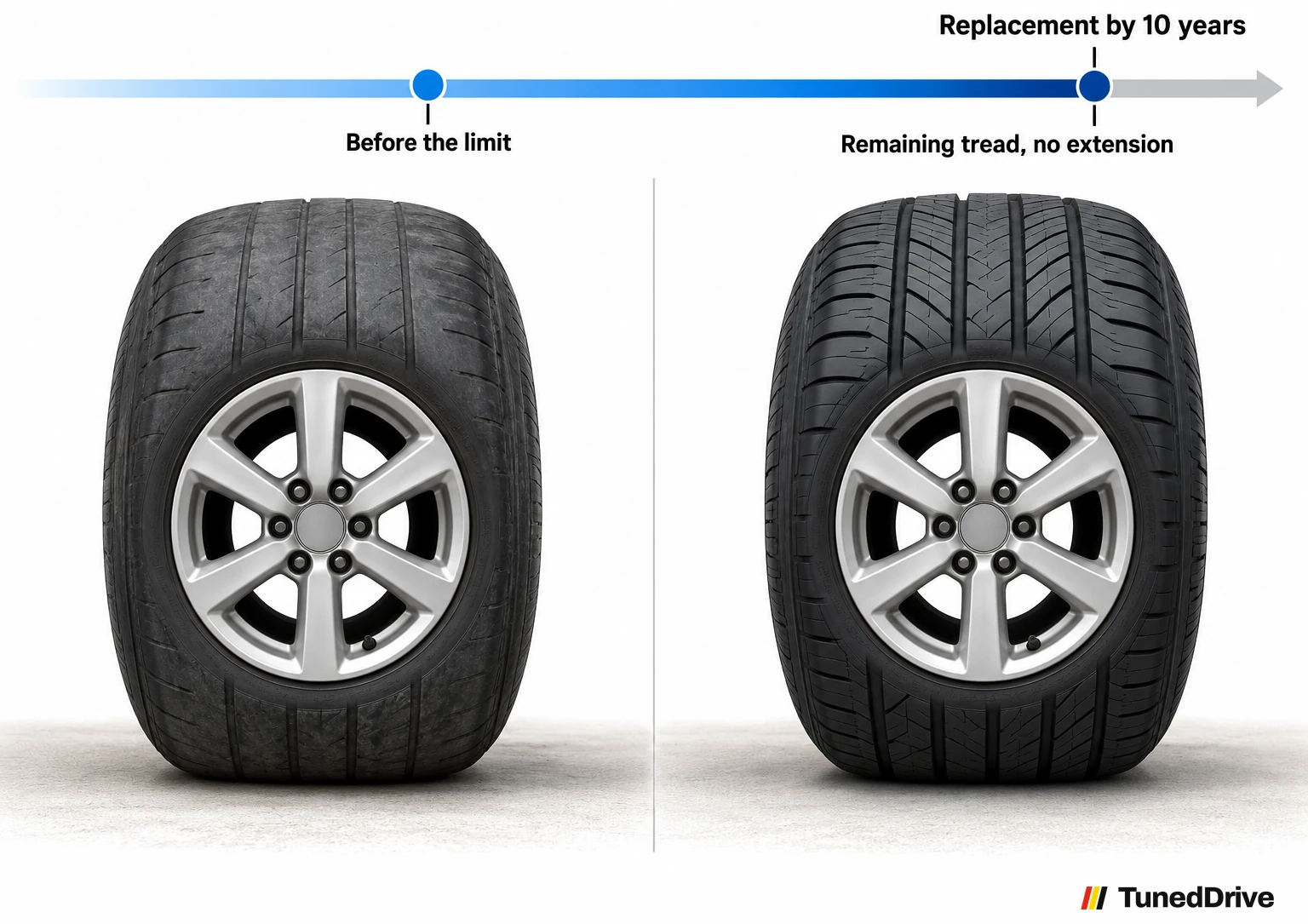
Use the code when you're buying
When you're considering a used vehicle or tires that may have been in storage, include the date marking in your buying checks. Michelin specifically identifies these situations for checking the code. The useful question is when the tire was manufactured, because that's the starting date for the age calculation.
Keep a later purchase date separate from that calculation. A tire marked 2524 retains its 25th-week-of-2024 manufacture date when you buy it later. Buying it changes when it becomes yours; the printed production date remains the reference for Michelin's inspection and age-based replacement guidance.
Before choosing it, put the decoded manufacture date beside your assessment of tread wear and overall condition. That lets you consider both the calendar position and the tire's current state in the buying decision. Use the production date to determine which age checkpoint comes next, or whether the replacement point has already passed.
More in this category
Continue at the systems desk
- What Is Speed Rating on Tires? Reading the Sidewall Letter
- How to Use an OBD2 Scanner and Save the Evidence
More from the wire