Find the letter beside the load rating
- A tire speed rating is the letter showing its maximum sustained speed capability under specified load conditions.
- Look on the sidewall beside the load rating. In 91V, the speed-rating symbol is V.
- Proper inflation and loading are conditions of the rating. Keep those conditions attached to any speed you look up.
When you're facing a sidewall full of numbers and letters, we'd find the service description first because it groups the load and speed ratings together. That gives you a specific place to look, instead of trying to interpret every marking around the tire.
The word “sustained” matters here: the rating concerns speed the tire can maintain over time. Tire manufacturers test their tires and assign the ratings, so the letter represents a defined capability category. Reading it involves two separate jobs: identifying the symbol on your tire and translating that symbol into a maximum-speed value.
Read a complete sidewall example
Look for the tire-size marking on the sidewall. Michelin's US explanation of tire markings (opens in a new tab) uses 205 / 55 R 17 91 V as its illustration. For the speed rating, the part you want is at the end of that example: the number-and-letter pair 91 V.
Within that pair, 91 identifies the load rating and V identifies the speed rating. Michelin also writes the pair together as 91V. The space changes how the example looks on the page, but you're still reading the same two elements: a load number followed by a speed letter.
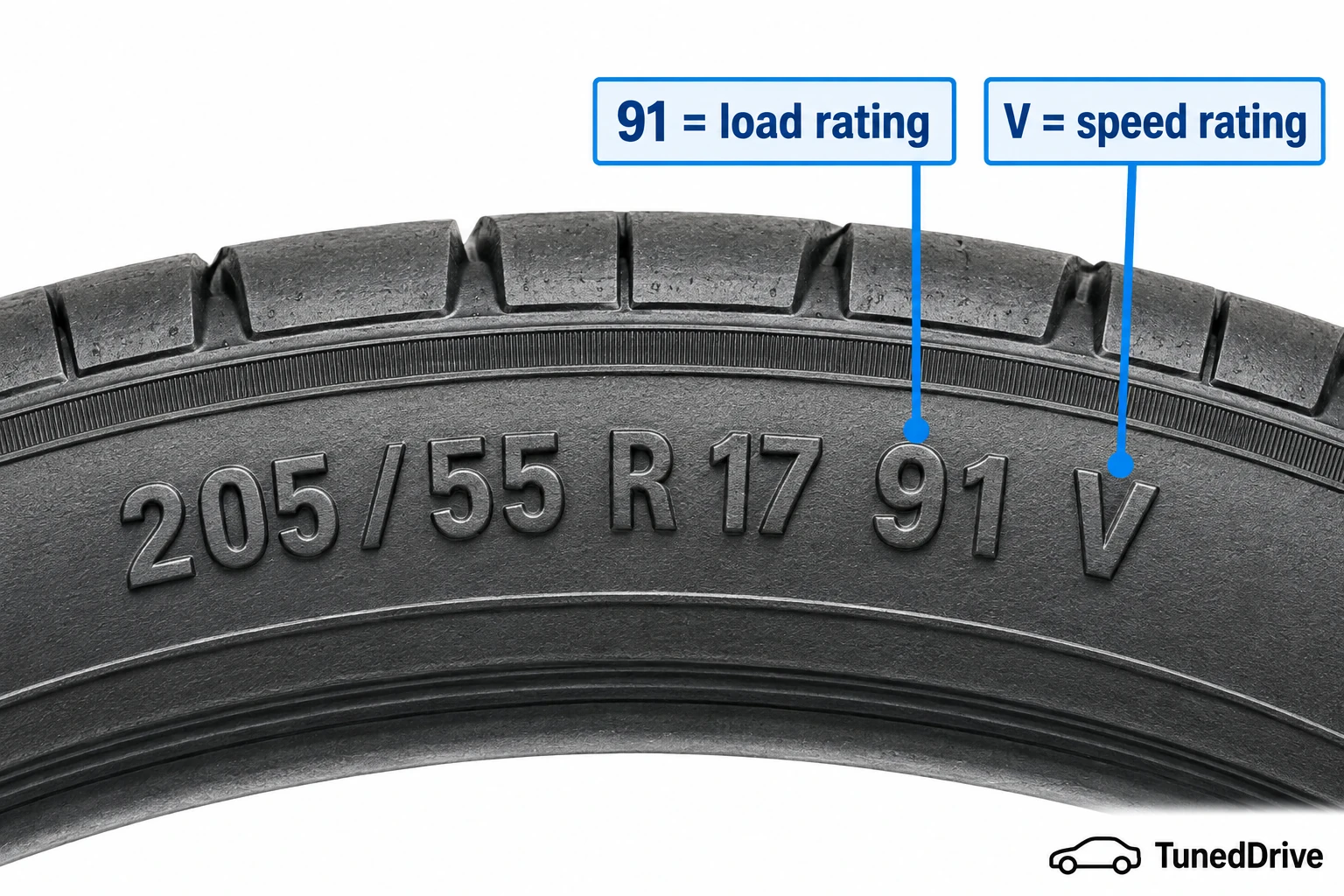
The longer tire-size string combines information about dimensions, aspect ratio, construction and the service description. That explains why picking out any letter in the string isn't enough to identify the speed rating. Use its position next to the load rating to distinguish the operating-rating pair from the other information in the marking.
The neighboring number answers a weight question
Think of the adjacent characters as answering different questions. The load rating concerns how much weight the tire can carry, while the speed rating concerns how fast it can sustain travel under specified conditions. In the example, 91 is a load-rating code, so reading it as 91 mph would give the number the wrong meaning.
The two ratings are separate, but their meanings are connected. The speed letter describes the maximum speed at which the tire can carry its maximum load under specified conditions. You're interpreting speed capability with a loading condition attached, rather than a speed figure that stands apart from the weight the tire carries.
If you're recording the marking, copy the whole service description before labeling its parts. For this illustration, your note would read “91V, load rating 91, speed rating V.” Keeping the pair together preserves both pieces of information, while the labels make clear which character belongs in a speed-rating lookup.
Other codes identify other tire characteristics
Your tire's sidewall also carries information about its dimensions, manufacturer and other characteristics. Some markings identify the tire itself or its original-equipment application. That broader collection is useful context when you're looking around the sidewall: several different codes can appear on the same tire without all describing its speed capability.
For a Chevrolet-related example, most original-equipment tires designed to GM's specific tire performance criteria have a TPC specification code molded onto the sidewall. The Chevrolet US tire maintenance support page (opens in a new tab) identifies that marking as a TPC code, separately from the letters in its speed-rating chart.
Many vehicle manufacturers also require suppliers to identify original-equipment tires with symbols or codes on their sidewalls. Recognizing that these identification markings have their own purpose helps you sort what you're reading. The service description is the particular part that puts the load rating and speed rating next to each other.
Chevrolet's chart gives the letters a speed value
Use the symbol you've identified to find its corresponding maximum speed. As a worked chart example, the Chevrolet US tire maintenance support page (opens in a new tab) lists these four entries in miles per hour. They describe tire-rating categories, rather than a required rating for a particular Chevrolet vehicle.
| Speed-rating symbol | Maximum speed in mph |
|---|---|
| M | 81 |
| H | 130 |
| V | 149 |
| Y | 186 |
For an H-versus-V comparison, H corresponds to 130 mph and V corresponds to 149 mph. V therefore represents the higher maximum-speed category of those two. That comparison answers a specific question about the symbols' speed meanings, without requiring you to interpret the rest of a tire's size marking.
Keep the units with the value when you read across the chart. Its numbers are maximum speeds in mph, while the number beside the letter on the tire is a load rating. Moving from the sidewall to the chart changes which kind of number you're reading.
What the V example means in practice
Applying that lookup to the illustrative 91V marking gives you a V-rated tire designed to handle speeds up to 149 mph when properly inflated and loaded. Michelin's V-rating explanation (opens in a new tab) puts those operating conditions directly alongside the speed, so they're part of the meaning you're reading.
“Up to” identifies the number as a maximum capability. It doesn't turn the figure into an unconditional safe driving speed. The useful interpretation is a statement about what the tire is designed to sustain under its specified conditions, with proper inflation and loading included in that statement.
You can check your interpretation by separating the questions you've answered. Finding V tells you which speed category is marked on the tire. Looking up that category supplies its speed value. The surrounding service description keeps the load rating available as a separate piece of information about the tire's operating limits.
Why the operating limits matter
The reason these boundaries matter is heat. Exceeding a tire's load or speed limits can cause excessive heat buildup, which may reduce durability and increase the risk of tire damage or failure. That consequence applies to the operating limits as a pair, so the speed letter is only one part of understanding them.
A speed-rating explanation naturally draws your eye to mph, but the weight boundary still matters alongside it. Michelin's US guidance on tire operating limits (opens in a new tab) connects the heat risk to exceeding load or speed limits. Keep within both limits when using the tire.
More in this category
Continue at the systems desk
More from the wire