The part behind the name
- If someone says “tire hub,” the part to look for is the wheel hub assembly. It attaches the wheel to the car and lets the wheel turn.
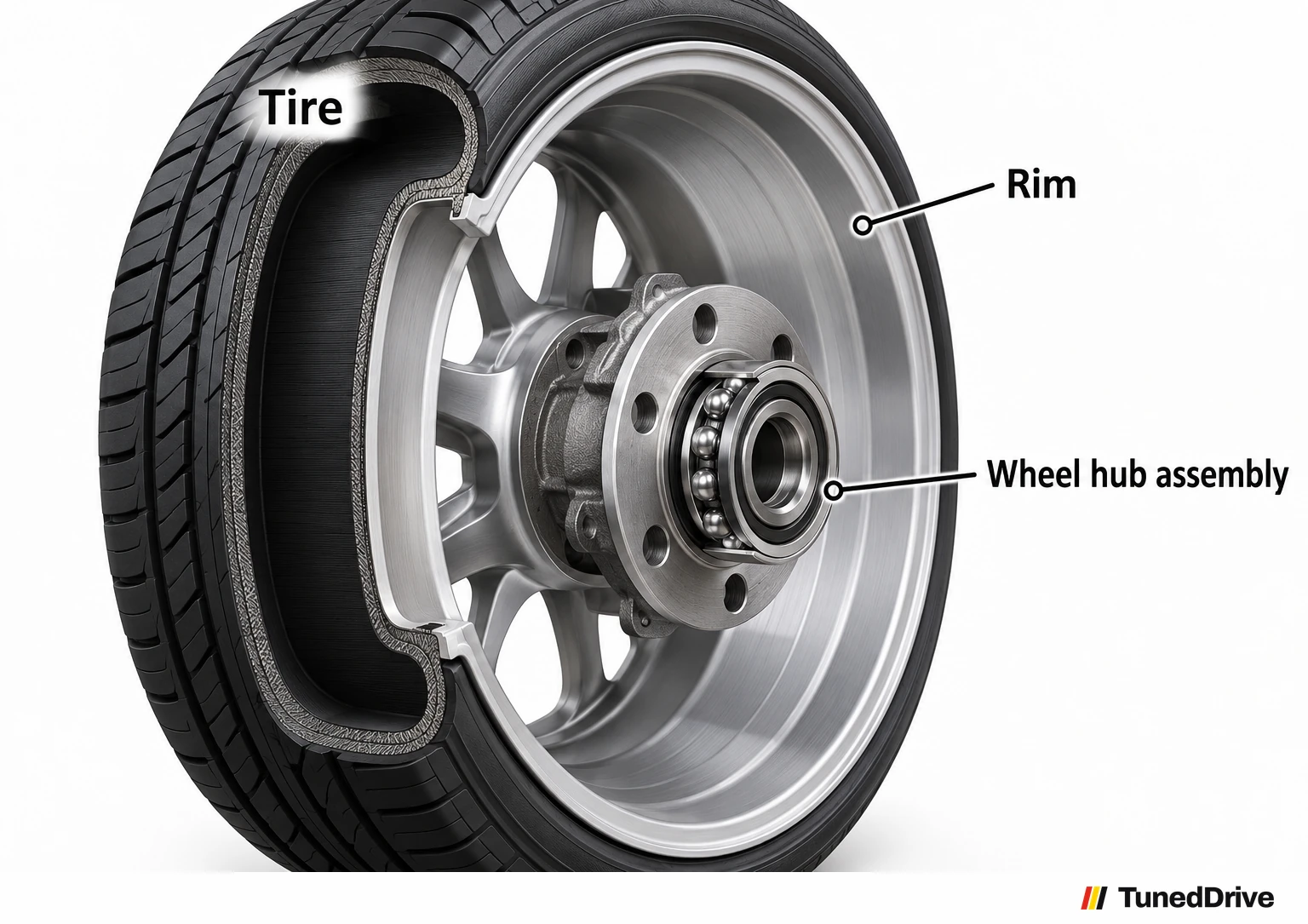
- The tire mounts on the wheel’s rim. The wheel fastens to the hub farther in.
- If a sound, steering shake or ABS light has you concerned about the hub, have a trusted mechanic assess it.
If a sound sent you searching for a part name, we’d sort the pieces from the outside inward first, because the tire sits on the rim while the hub holds the wheel to the car. That gives you a way to describe where the concern seems to be without choosing a failed part from a symptom.
The rim is the part of the wheel where the tire mounts, and the tire’s bead holds it against that rim. The wheel hub assembly is farther in, at the wheel’s attachment to the vehicle. You may also hear it called a wheel hub bearing, hub unit, or hub and bearing assembly.

Where the assembly sits
The wheel fastens to bolts on the hub assembly. Inward from there, the assembly mounts at the steering knuckle, alongside the brake disc or drum. That puts the hub at the connection between the wheel and the vehicle, while the rim remains the portion of the wheel carrying the tire.
Its essential jobs are to keep the wheel attached and allow it to turn freely for steering. The bearing in an assembled unit supports that rotation. When you hear “hub” and “bearing” used together, they describe related jobs at the same wheel attachment.
An assembly’s inward mounting can be bolted on or pressed in. Those arrangements describe how the unit meets the steering knuckle; they don’t change which part the tire mounts to or what holds the wheel to the car.
Why hub and bearing names overlap
A wheel hub assembly combines the wheel’s attachment with bearings and seals in a preassembled unit. A bearing is the part associated with the wheel’s free rotation. That distinction helps when someone describes a concern as a “hub” problem and someone else calls it a “bearing” problem.
MOOG says most late-model vehicles made since 1998 have a hub assembly at each wheel, with a failed assembly replaced as a unit. For cars made before 1997, it describes front-wheel-drive cars with hub assemblies at each wheel and rear-wheel-drive cars with two individual bearings and seals in each front wheel. Those individual bearings can be serviced.
The vehicle’s arrangement therefore matters to the words used for the part. A combined assembly and an individual bearing both concern wheel rotation, but they aren’t the same construction. If you’re discussing a suspected fault, give the mechanic the symptom you noticed and let the vehicle’s design guide which part needs attention.
Why the metal parts can look different
The bearing and wheel mounting points can be combined in several ways. In SKF’s HBU1 design, an outer ring and two inner rings form a greased, sealed bearing unit. It’s used mainly on driven wheels, though this design also appears with an integral drum on the non-driven wheels of smaller cars.
In SKF’s HBU2 design, a flange on the bearing’s outer ring takes the place of a separate hub. Its threaded holes or studs provide mounting points for the brake and wheel. This version is typically used with a rotating outer ring on non-driven front or rear wheels.
SKF’s HBU3 design has a flange for the wheel and brake rotor and another for attaching the unit to the suspension. It’s a greased, sealed unit used on both driven and non-driven wheels. These designs explain why the metal parts may look different while still providing a place to mount the wheel and a bearing for its rotation.
How the hub can relate to an ABS light
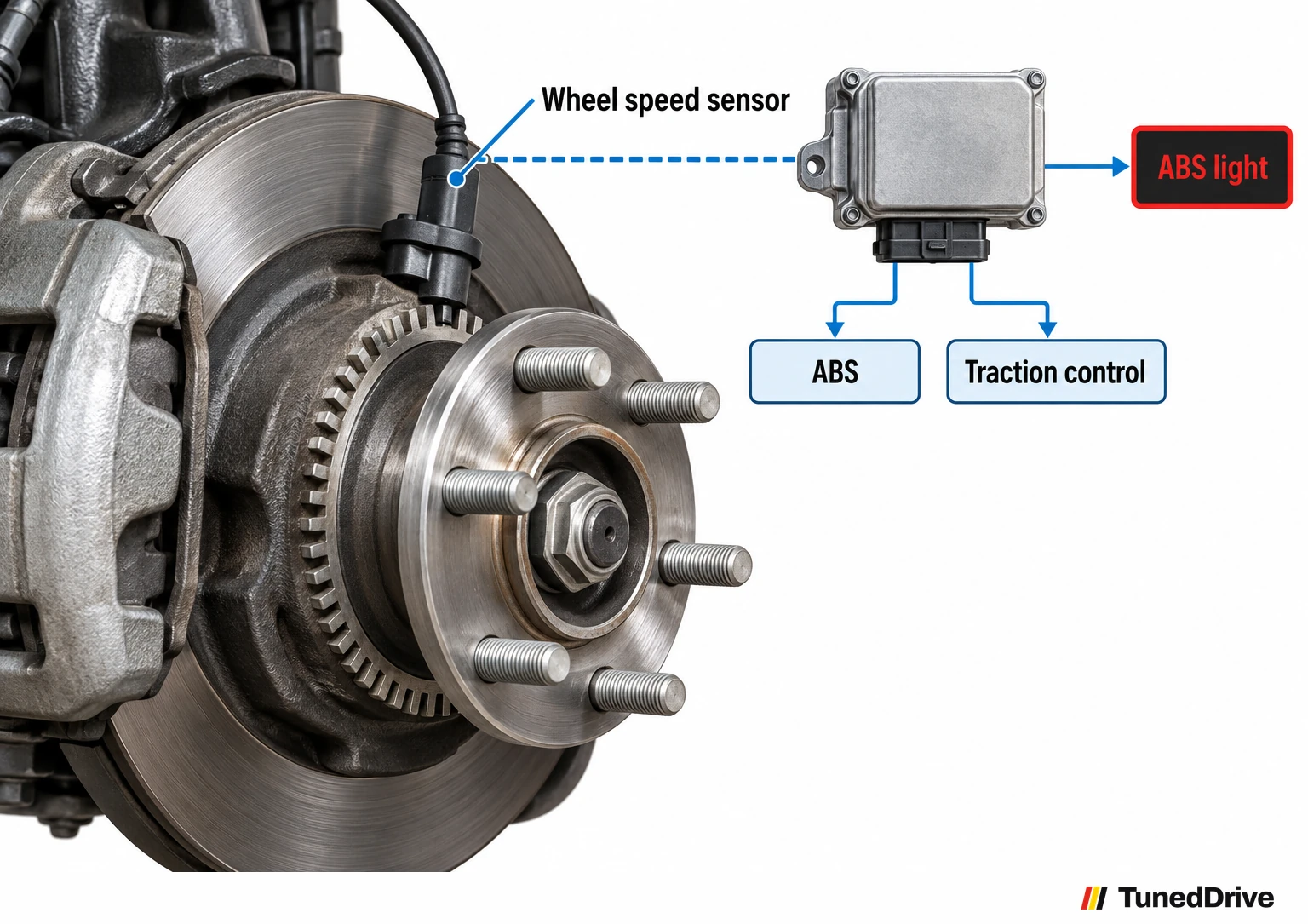
On a hub assembly equipped with a wheel-speed sensor, that sensor sends the anti-lock braking system, or ABS, information about how fast the wheel is turning. During hard braking, ABS uses that information to decide whether anti-lock braking is needed.
Traction control also uses ABS wheel sensors. If one of those sensors fails, both ABS and traction control can be affected. That’s why a question about the hub can involve an electrical signal as well as the bearing and wheel attachment.
An ABS light can come on when a wheel-speed sensor reads improperly or its signal is lost. Note the light and any other symptom you noticed with it, so the mechanic can assess the warning alongside the rest of the concern.
What a hub problem might sound like
A failing hub assembly may make a growling, humming, squeaking, chirping or squealing sound while the car is moving. One described pattern occurs at 30 to 45 mph. If you’ve already heard a sound in that range, remember what it sounded like and when it happened.
The sound is a clue for a mechanic, rather than a part number for you to choose. Hub assembly failure can show up in different ways, so give the mechanic the sound you heard and the circumstances you remember. There’s no need to drive again just to reproduce it.
A shake and a wobble give different clues
A steering wheel that shakes while you drive can be another hub assembly symptom. If what you noticed was a wheel wobbling from side to side, tell the mechanic that separately. Improperly balanced tires, poor alignment and a bent wheel can also cause that kind of wobble.
Keep the distinction practical: describe whether you felt the steering wheel shake or saw a wheel wobble, and when you noticed it. Those observations give the mechanic more to work with than calling either one a failed hub.
The details to keep together
Write down the symptoms you already noticed: the kind of sound, whether the steering wheel shook or a wheel wobbled, and whether the ABS light appeared. If you remember when a sound occurred, include that detail. Use what you observed on the trip instead of driving to recreate a symptom.
When you describe the concern, keep the parts in order: the tire mounts on the rim, the wheel fastens to the hub, and the bearing supports its rotation. Give the mechanic your observations along with the part name you were asking about, so the service decision starts with what happened at the car.
Preferred source
See more TunedDrive on Google
Select TunedDrive in Google’s source preferences. It takes a few seconds and costs nothing. Our car news, reviews and fixes become more likely to appear in your Top Stories, and AI Overviews can mark them as preferred.
More in this category